AWS Infrastructure as Code: The Complete Guide to Automating Your Cloud Infrastructure -owias

•
1 min read
•
1 min read
Mughees Siddiqui
Co-Founder / AWS Cloud Architect

Mughees Siddiqui helps startups and engineering teams design scalable, secure, and cost-efficient solutions on AWS. His expertise spans AWS serverless architecture, generative AI, and modern frameworks to turn ideas into production-ready products.
Products
150+
Connections
500+
Experience
7+ Years
To share your Project Details
Table of contents
What Is AWS Infrastructure as Code and Why It Matters
AWS Infrastructure as Code Tools
Third-Party Infrastructure as Code Tools for AWS
How to Implement AWS Infrastructure as Code Step by Step
AWS Infrastructure as Code Best Practices and Design Patterns
AWS Infrastructure as Code Security, Governance, and Compliance
AWS Infrastructure as Code Adoption and Migration Strategies
Real-World AWS Infrastructure as Code Examples and Case Studies
FAQs
Conclusion
Managing cloud resources through manual console clicks is becoming unsustainable as AWS environments grow increasingly complex. Teams waste countless hours on repetitive tasks while risking configuration errors.
AWS Infrastructure as Code (IaC) transforms how organizations manage cloud resources. Instead of clicking through console interfaces, you define infrastructure using code files. These templates create, update, and delete AWS resources automatically.
Teams using infrastructure as code AWS deploy 3x faster with 50% fewer errors according to recent DevOps reports. Automation reduces deployment times from hours to minutes. Version control tracks every infrastructure change. Teams can instantly replicate environments across regions.
Modern DevOps practices demand automated infrastructure provisioning. CI/CD pipelines require consistent environments. Rapid scaling needs repeatable deployments.
This guide covers AWS infrastructure as code tools like CloudFormation and CDK. You'll learn security best practices, migration strategies, and real-world implementation examples.
Understanding the fundamentals of AWS IaC helps teams make informed decisions about automation strategies.
Infrastructure as code aws meant to define cloud resources through templates and configuration files. These text files describe your desired AWS infrastructure state. Automation tools read these files and create the specified resources.
Templates define everything from VPCs to Lambda functions. Configuration files specify resource properties and relationships. AWS interprets these files and provisions resources automatically.
The infrastructure becomes versionable and repeatable. Teams can review changes before deployment. Rollbacks become simple file reversions.
Automation eliminates manual configuration errors. Teams deploy identical environments consistently. Infrastructure changes become traceable through version control.
Speed improvements are dramatic. HashiCorp's 2024 State of IaC Report shows 87% faster deployments. Cost optimization improves through automated resource tagging and monitoring.
Repeatability ensures development matches production. Testing becomes more reliable. Disaster recovery simplifies to running existing templates.
Learning curves vary by tool complexity. CloudFormation requires YAML/JSON knowledge. The AWS CDK needs programming skills.
State management creates synchronization challenges. Infrastructure drift occurs when manual changes bypass IaC. Security misconfigurations can propagate across environments.
Teams need governance frameworks. Access controls must balance automation with security. Testing strategies require new approaches.
AWS offers multiple native tools while supporting third-party solutions for diverse team needs.
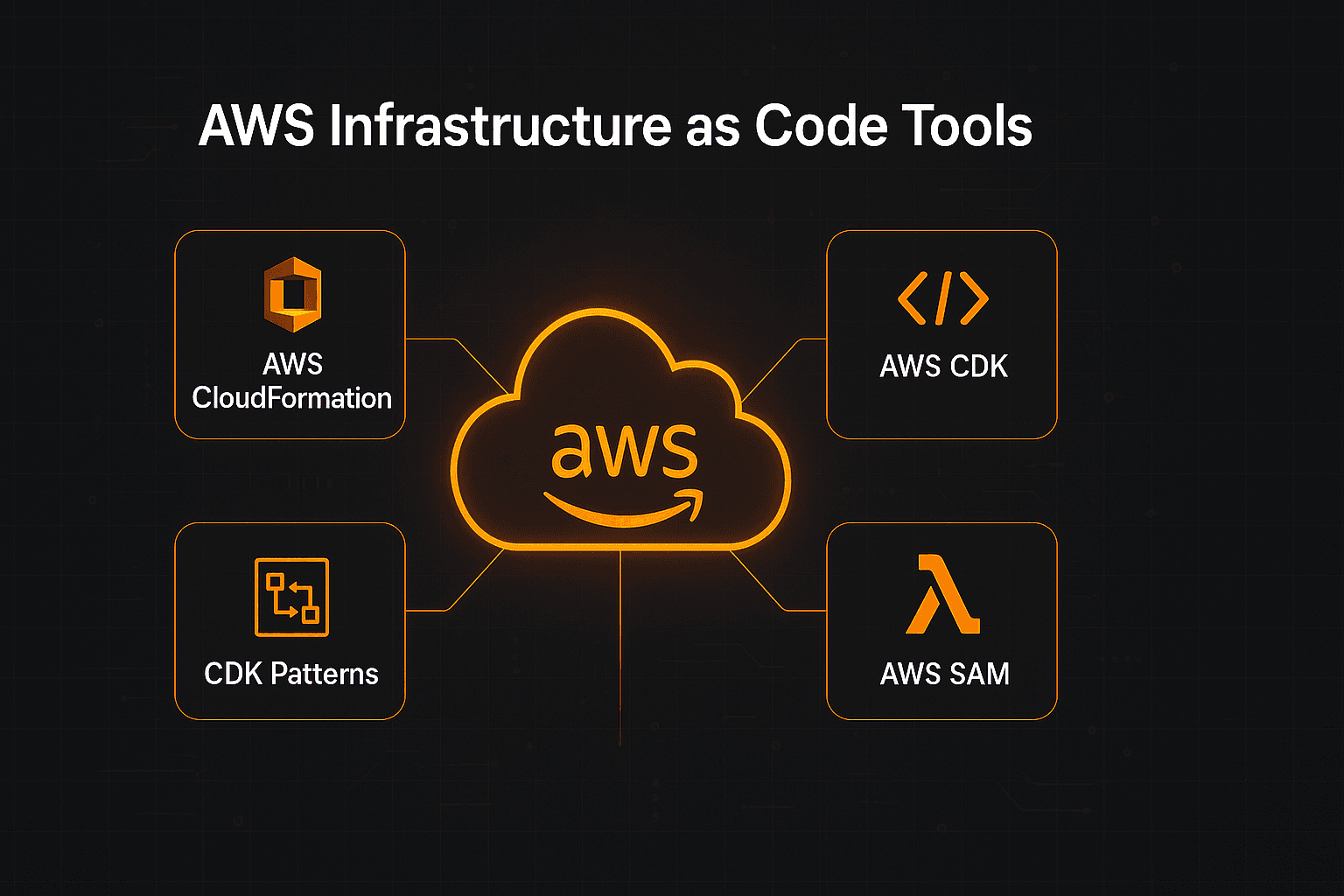
AWS CloudFormation infrastructure as code uses YAML or JSON templates. Stacks group related resources together. Templates define resource properties and dependencies.
CloudFormation handles resource ordering automatically. It manages creation, updates, and deletion sequences. Rollback capabilities protect against failed deployments.
AWS maintains extensive template libraries. The service integrates deeply with other AWS services. Change sets preview modifications before applying them.
CDK supports TypeScript, Python, Java, and C#. Developers write infrastructure using object-oriented concepts. The toolkit synthesizes code into CloudFormation templates.
Higher-level constructs simplify complex patterns. Teams share reusable components through libraries. IDE features like autocomplete improve productivity.
CDK reduces template complexity significantly. A few lines of code replace hundreds of YAML lines. Type checking catches errors before deployment.
AWS SAM simplifies Lambda and API Gateway deployments. Templates focus on serverless-specific resources. Local testing capabilities speed development cycles.
CDK Patterns provide pre-built serverless architectures. Common patterns include API backends and data processing pipelines. AWS lambda infrastructure as code becomes more accessible.
Third-party tools offer additional features and multi-cloud capabilities beyond AWS-native solutions.
HashiCorp Configuration Language (HCL) defines resources clearly. State files track deployed infrastructure. The AWS provider supports all major services.
Terraform modules enable code reusability. Teams share modules through registries. Multi-cloud support future-proofs infrastructure investments.
Plan commands preview changes before applying. Import features help migrate existing resources. Workspace management separates environments effectively.
Teams use Python, TypeScript, or Go for infrastructure. Object-oriented patterns improve code organization. Testing frameworks validate infrastructure logic.
Pulumi integrates with existing development workflows. IDE support enhances productivity. Stack references enable cross-stack dependencies.
OpenTofu maintains Terraform compatibility. Crossplane uses Kubernetes-style APIs. These tools avoid vendor lock-in concerns.
Community-driven development ensures transparency. Organizations maintain control over tooling decisions. Integration capabilities continue expanding.
CloudFormation excels for AWS-only environments. It offers deep service integration and AWS support. Learning curve focuses on template syntax.
CDK suits development teams preferring code over configuration. Programming language flexibility improves adoption. Abstraction layers simplify complex patterns.
Terraform provides multi-cloud flexibility. Mature ecosystem includes extensive modules. State management requires careful planning.
Pulumi combines programming languages with cloud resources. Testing becomes easier with familiar frameworks. Smaller community compared to alternatives.
Practical implementation requires careful planning and incremental adoption strategies.
Start with network foundations using VPCs and subnets. Security groups control traffic flow. Load balancers distribute requests across instances.
EC2 instances or containers host applications. RDS manages database requirements. S3 stores static assets and backups.
Each component becomes a template section. Dependencies ensure proper creation order. Parameters enable environment-specific configurations.
YAML improves readability over JSON. Resources specify types and properties. Outputs export values for cross-stack references.
Parameters accept runtime values. Mappings provide conditional configurations. Functions transform values dynamically.
CDK uses class instantiation for resources. Terraform declares resources with HCL blocks. Pulumi combines programming constructs with cloud resources.
Each tool handles dependencies differently. CDK infers relationships from code. Terraform uses explicit references. Pulumi leverages language features.
AWS CodePipeline orchestrates deployment stages. CodeBuild validates templates before deployment. GitHub Actions provides alternative automation.
Pipeline stages include linting, testing, and deployment. Approval gates control production changes. Rollback mechanisms handle failures gracefully.
Following established patterns improves maintainability and reduces operational risks.
Separate concerns into distinct modules. Network modules handle VPC configurations. Application modules manage compute resources.
Modules accept parameters for customization. Outputs enable module composition. Version control tracks module changes independently.
Feature branches isolate infrastructure changes. Pull requests enable peer review. Main branches trigger automatic deployments.
GitOps principles automate deployments from repositories. Infrastructure state matches repository contents. Drift detection identifies unauthorized changes.
Static analysis tools catch syntax errors. Tools like cfn-lint validate CloudFormation templates. Terraform has tflint for similar purposes.
Unit tests verify module logic. Integration tests validate resource creation. Compliance tests ensure security standards.
AWS Config monitors resource configurations. CloudFormation drift detection identifies changes. Terraform refresh commands update state files.
Regular drift checks catch manual modifications. Automated remediation restores desired states. Alerts notify teams of detected drift.
Hard-coded secrets create security vulnerabilities. Use AWS Secrets Manager instead. Missing resource tags complicate cost tracking.
Monolithic templates become unmaintainable. Lack of testing increases failure risks. Ignoring drift leads to configuration inconsistencies.
Security considerations must integrate throughout the IaC lifecycle.
AWS Service Control Policies restrict account actions. AWS Config rules validate resource compliance. Open Policy Agent provides flexible policy frameworks.
Policies check encryption requirements. They enforce tagging standards. Network configurations undergo automatic validation.
AWS Secrets Manager stores sensitive data securely. SSM Parameter Store manages configuration values. IAM roles provide temporary credentials.
Never embed credentials in templates. Rotate secrets regularly through automation. Audit access patterns continuously.
Checkov scans for security misconfigurations. Tools like cfn-nag enforce security policies. Scanning integrates into CI/CD pipelines.
Regular scans catch emerging vulnerabilities. Reports highlight remediation steps. Compliance dashboards track security posture.
CIS benchmarks provide security baselines. AWS Audit Manager automates evidence collection. Reports demonstrate compliance status.
Automated checks reduce manual auditing. Evidence collection becomes continuous. Compliance gaps trigger immediate alerts.
Successful adoption requires thoughtful planning and phased implementation.
AWS CloudFormer generates templates from existing resources. Terraform import commands add resources to state. Manual documentation speeds migration planning.
Start with non-critical resources. Validate imported configurations carefully. Test thoroughly before switching management.
Gradual adoption reduces risk. Teams learn incrementally. Failures have limited impact.
Big bang approaches provide consistency faster. They require extensive planning. Rollback strategies become critical.
Most organizations benefit from gradual adoption. Start with new projects. Migrate existing infrastructure systematically.
AWS Organizations centralize account management. StackSets deploy across multiple accounts. Cross-region replication ensures global availability.
Separate accounts isolate environments. Centralized tooling accounts manage deployments. Audit accounts aggregate compliance data.
Practical examples demonstrate IaC benefits in production environments.
Web applications use ALB, Auto Scaling, and RDS. Data pipelines combine Kinesis, Lambda, and S3. Serverless APIs leverage API Gateway and DynamoDB.
Each pattern includes security best practices. Monitoring integrations ensure observability. Cost optimization techniques reduce expenses.
Netflix manages thousands of microservices through IaC. Their deployment velocity increased 4x. Error rates dropped by 60%.
Capital One standardized on AWS code as infrastructure. Deployment times reduced from days to minutes. Security compliance improved through automation.
Airbnb uses Terraform for multi-region deployments. Infrastructure consistency improved dramatically. Development teams gained self-service capabilities.
Deployment frequency increases 5-10x typically. Infrastructure provisioning time drops 80%. Configuration errors decrease by 70%.
Cost savings average 20-30% through optimization. Compliance audit times reduce by 60%. Recovery time objectives improve significantly.
AWS Infrastructure as Code defines cloud resources using text files instead of manual configuration. These files describe desired infrastructure states. AWS services read templates and automatically provision specified resources.
CloudFormation offers the gentlest learning curve for AWS-focused teams. AWS CDK suits developers comfortable with programming. Terraform provides good documentation for infrastructure beginners.
CloudFormation integrates deeply with AWS services and requires no state management. Terraform offers multi-cloud support and a mature module ecosystem. CloudFormation updates can be slower than Terraform changes.
Yes, IaC tools detect when actual infrastructure differs from defined templates. AWS Config and CloudFormation drift detection identify unauthorized changes. Regular drift checks maintain configuration consistency.
Policy as Code automates compliance and security rule enforcement. Rules validate infrastructure before deployment. AWS Config and Service Control Policies provide policy frameworks.
Never hard-code secrets in templates. Use AWS Secrets Manager or Parameter Store. Reference secrets dynamically during deployment. Implement rotation policies automatically.
Validate syntax with linting tools first. Test modules independently before integration. Use separate AWS accounts for testing. Implement automated compliance checks.
IaC enables consistent resource tagging for cost tracking. Automated cleanup removes unused resources. Standardized configurations prevent overprovisioning. Right-sizing becomes systematic across environments.
Yes, tools like CloudFormer and Terraform import help migrate resources. Start with resource documentation. Import non-critical resources first. Validate configurations thoroughly.
Avoid hard-coding values that change between environments. Don't create monolithic templates. Never store secrets in version control. Prevent manual changes that bypass IaC.
Choose CDK when teams prefer programming languages over YAML. CDK excels for complex logic and abstractions. CloudFormation suits teams wanting declarative templates.
IaC enables automated environment provisioning in pipelines. Consistent environments improve testing reliability. Version control enables infrastructure rollbacks. Teams deploy infrastructure alongside application code.
AWS CDK supports TypeScript, JavaScript, Python, Java, and C#. TypeScript offers the best documentation and examples. Python suits data engineering teams. Java and C# integrate with enterprise codebases.
AWS Infrastructure as Code fundamentally transforms cloud resource management. Teams gain speed, consistency, and reliability through automation. Manual errors disappear while deployment velocity increases dramatically.
Success requires choosing appropriate tools for your context. CloudFormation suits AWS-native teams. CDK appeals to developers. Terraform provides multi-cloud flexibility.
Start small with new projects before migrating existing infrastructure. Implement testing and security scanning early. Build modular, reusable components for long-term maintainability.
AWS provides extensive documentation and workshop materials. The CDK Patterns repository offers practical examples. Community resources continue expanding rapidly.
Begin your AWS Infrastructure as Code journey today with a pilot project. Contact GeeksVisor for expert AWS IaC implementation services and consulting to accelerate your automation transformation.
Modern Tech Stack
Inquiries
GeeksVisor
Follow us on Social Media


Copyright © 2026 All rights reserved by Geeksvisor